At the nanoscale, the interaction between a particle and the surface beneath it can influence whether the particle remains in place or can be displaced. Quantifying this interaction for individual nanoparticles, however, requires more than observing where they are located. It requires a way to manipulate a selected particle while measuring its response.
Çiçek and colleagues explored this problem using copper (Cu) nanoparticles on silicon (Si). They investigated how particle size and deposition conditions relate to adhesion-related behaviour using AFM imaging, controlled nanoparticle manipulation and force measurement.
The experiments followed an established AFM nanomanipulation approach. Areas with sufficiently low nanoparticle coverage were selected so that individual particles could be manipulated independently. Using NANOSENSORS Uniqprobe qp-CONT AFM probes, the researchers first located the Cu nanoparticles by AFM topography and then deliberately pushed selected particles while recording the lateral-force response. The cantilevers were calibrated for quantitative lateral-force measurements, allowing the recorded signal to be related to the force acting during manipulation.
As the AFM tip encountered a nanoparticle, the lateral-force signal increased as the particle was displaced from its initial position. The subsequent response also contained contributions associated with friction and other dissipative processes during manipulation. By considering both force and displacement, rather than lateral force alone, the researchers could determine the total work of manipulation and use it to estimate the work of separation.
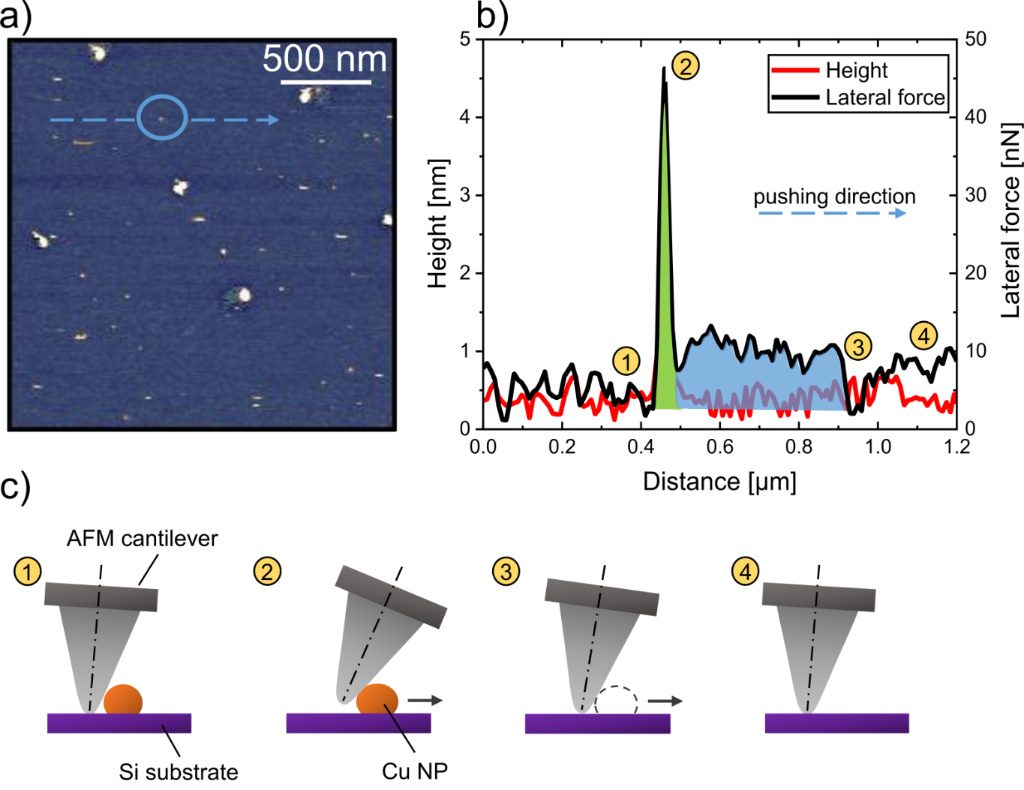
AFM manipulation of a Cu nanoparticle on a Si substrate to investigate nanoparticle–substrate adhesion. (a) AFM topography identifies the selected nanoparticle and pushing direction. (b) The corresponding height and lateral-force profiles show the force response during displacement; the green area represents the work of separation used in the adhesion analysis, while the blue area represents work associated with friction. (c) Schematic representation of the AFM cantilever–nanoparticle interaction during the pushing sequence. Measurements were performed using NANOSENSORS Uniqprobe qp-CONT AFM probes. Figure 4 from the featured publication by Çiçek et al.; see the publication cited below for the complete figure description and scientific context.
Figure 4 follows this process for a selected Cu nanoparticle. AFM topography identifies the particle and pushing direction, while the height and lateral-force profiles follow its displacement. The initial force response contributes to the work-of-separation analysis. The later response includes work associated with friction. The schematic relates these signals to the cantilever–nanoparticle interaction during the pushing sequence.
This distinction became important when the results were compared across the different experimental conditions. Lateral force alone did not show a simple trend with substrate bias. Considering force over the displacement distance provided additional information about the nanoparticle–substrate interaction.
The measurements also showed a non-monotonic dependence on nanoparticle size. Under the conditions investigated, the strongest adhesion-related behaviour was typically reported for particles between 6 and 12 nm rather than increasing continuously with particle size. Higher substrate bias and larger particles likewise did not automatically correspond to stronger adhesion. The reported size dependence is specific to the system and conditions studied and does not establish a universal optimum particle size.
Together, imaging, controlled manipulation and calibrated force measurement allowed the behaviour of individual nanoparticles to be followed from their initial position through deliberate displacement and quantitative analysis. At the same time, the resulting force response requires careful interpretation because it contains separation, friction and other dissipative contributions. The resulting work-of-separation values therefore remain estimates within the experimental and analytical framework used by the researchers.
Featured Publication
Aydan Çiçek, Markus Kratzer, Christian Teichert, Christian Mitterer
Quantitative estimation of nanoparticle/substrate adhesion by atomic force microscopy
Beilstein Journal of Nanotechnology 17, 1–14 (2026).
DOI: https://doi.org/10.3762/bjnano.17.1
Open access: Beilstein-Institut Open Access License Agreement, identical to Creative Commons Attribution 4.0 International (CC BY 4.0).
Image Attribution and License
Figure 4 from the featured publication by Aydan Çiçek, Markus Kratzer, Christian Teichert and Christian Mitterer. Beilstein Journal of Nanotechnology 17, 1–14 (2026). https://doi.org/10.3762/bjnano.17.1. Reproduced under the Beilstein-Institut Open Access License Agreement, identical to Creative Commons Attribution 4.0 International (CC BY 4.0): https://creativecommons.org/licenses/by/4.0/.