Skip to content

uniqprobes

Dynamics of Compartment-Specific Proteomic Landscapes of Hepatotoxic and Cholestatic Models of Liver Fibrosis
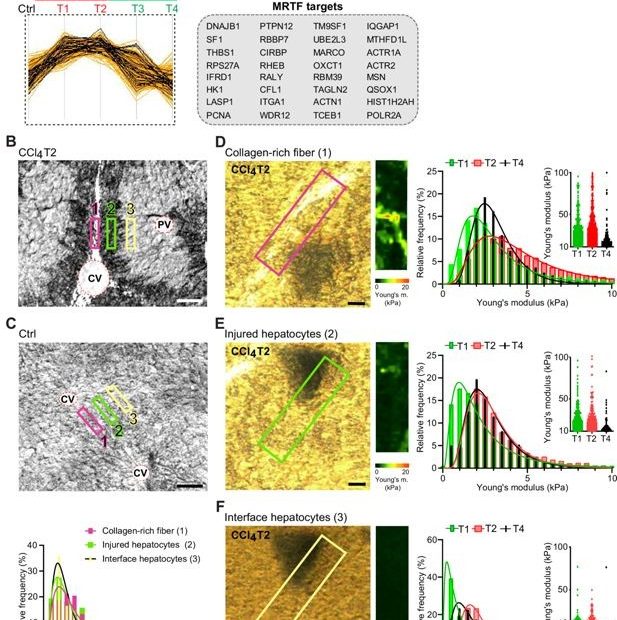
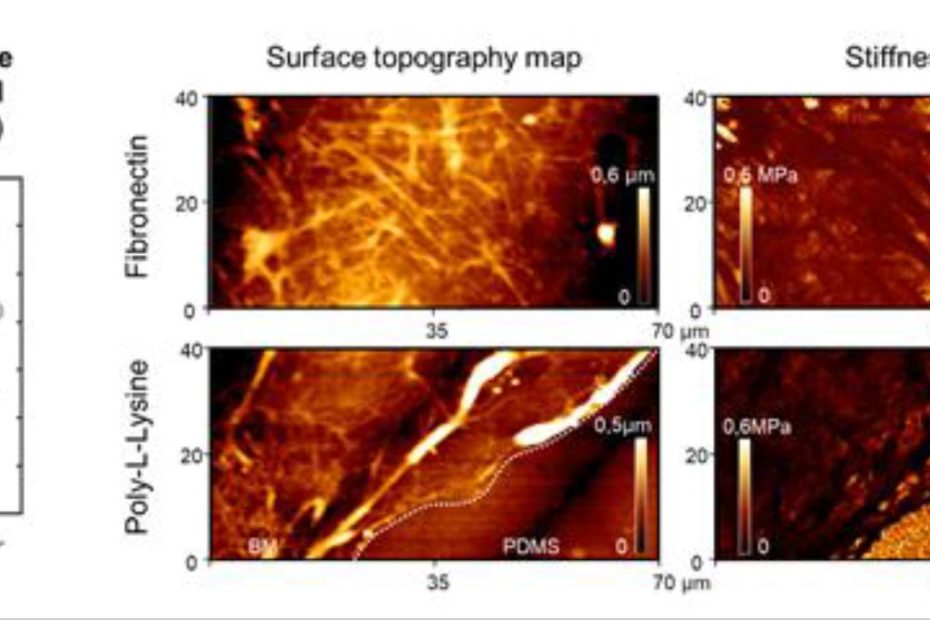
Atomic force microscopy (AFM) stiffness mapping reveals changes in the local mechanics of liver tissue upon hepatotoxic injury

Liver fibrosis is characterized by excessive accumulation and remodeling of extracellular matrix (ECM) components, leading to altered tissue mechanics and progressive impairment of liver function.… Read More »Dynamics of Compartment-Specific Proteomic Landscapes of Hepatotoxic and Cholestatic Models of Liver Fibrosis
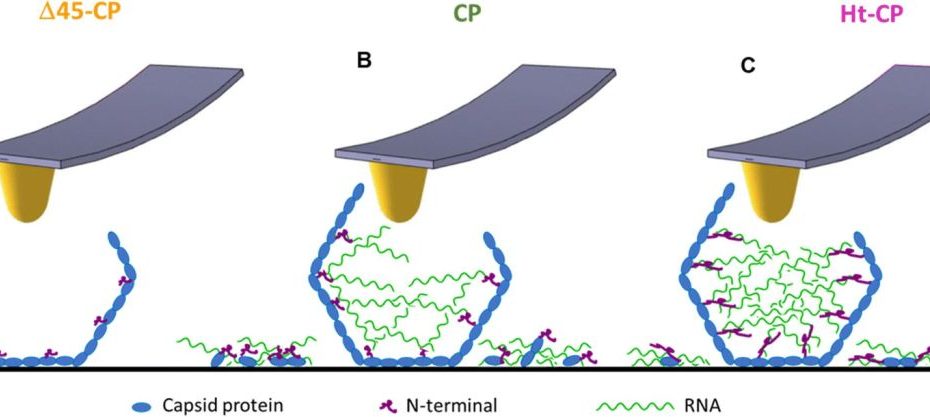
Mechanical disassembly of human picobirnavirus like particles indicates that cargo retention is tuned by the RNA-coat protein interaction

Fig. 6 from María J. Rodríguez-Espinosa et al. 2023: Model depicting the RNA cargo retention for each VLP variant. The Δ45-CP VLP structure (A) does not show externalized cargo. The CP VLP structure (B) shows shorter N-terminals compared to the Ht-CP structure (C), which implies less RNA cargo retention compared to the Ht-CP structure. The cartoons in blue, green and pink colors represent coat protein, RNA and N-terminal, respectively. For mechanical fatigue experiments, rectangular AFM cantilevers (NANOSENSORS™, uniqprobe qp-BioAC AFM probes with three different AFM cantilevers per chip) with nominal spring constants of 0.05 and 0.1 N m−1 were used. The AFM cantilevers were calibrated using Sader's method.

The idea of using virus-like particles as nanocarriers for heterologous cargo transport and delivery requires controlling the stability of the container–cargo system.* In particular, the… Read More »Mechanical disassembly of human picobirnavirus like particles indicates that cargo retention is tuned by the RNA-coat protein interaction

Accurate and rapid antibiotic susceptibility testing using a machine learning assisted nanomotion technology platform

Fig. 1 from Alexander Sturm et al. “Accurate and rapid antibiotic susceptibility testing using a machine learning-assisted nanomotion technology platform”: Nanomotion detection and recording platform. a Representation of the components of the nanomotion technology platform. b A representation of the nanomotion measurement setup with the (1) bacteria-loaded cantilever, (2) superluminescent light emitting diode (SLED) = light source, and (3) photodetector. c Schematic illustrating Gram-negative bacteria attached to the cantilever. Prior to attachment, bacteria are dispersed in gelling agarose while the cantilever surface is functionalized using positively charged poly-D-lysine. The gelling agent proved beneficial for an even distribution and stability of the bacterial attachment. d Representative standard 4-h nanomotion recordings with a 2-h medium phase (50% LB medium) followed by a 2-h drug phase with 32 µg/ml CRO for the E. coli reference strains ATCC-25922 (S, susceptible) and BAA-2452 (R, resistant). These recordings form the basis for using nanomotion to conduct AST. This study contains 219 recordings of ATCC-25922 and 225 recordings of BAA-2452 exposed to 32 µg/ml CRO with similar results. Data are available in the source data file. NANOSENSORSTM tipless uniqprobe AFM cantilevers SD-qp-CONT-TL from the NANOSENSORS Special Developments List were used.

Antimicrobial resistance (AMR) has become a significant threat to public health worldwide. * AMR diagnostic strategies such as antibiotic susceptibility testing (AST) help provide clinicians… Read More »Accurate and rapid antibiotic susceptibility testing using a machine learning assisted nanomotion technology platform