As nanowires become increasingly important components of sensors and other nanodevices, understanding their mechanical robustness is essential for reliable device design. In this article, Yoshinari Kimura, Sota Osari, Keiichi Shirasu, and Hironori Tohmyoh experimentally investigate the mechanical properties of individual iron oxide (Fe₂O₃) nanowires, combining in-situ mechanical testing inside a scanning electron microscope with a NANOSENSORS uniqprobe qp-fast AFM cantilever.
The Fe₂O₃ nanowires were formed through stress-induced migration during the thermal treatment of an iron plate substrate. Because their dimensions and mechanical properties can strongly influence the reliability of nanoscale devices, the researchers investigated both tensile and bending behavior of individual nanowires directly under controlled mechanical loading. The experimental approach enabled the researchers to evaluate the mechanical response of individual Fe₂O₃ nanowires rather than relying only on bulk material properties. In-situ tensile and bending tests were performed while the nanowires were observed inside the SEM, allowing their deformation and fracture behavior to be evaluated during mechanical loading.
The tensile strength of individual nanowires increased substantially as their diameter decreased. Measured tensile strengths ranged from 0.11 to 1.72 GPa, while the corresponding fracture diameters decreased from 840 to 130 nm. For nanowires attached to the substrate, bending tests produced a bending strength of approximately 1.31 GPa at fracture diameters between 251 and 381 nm. These results demonstrate the significant mechanical strength that can be achieved by nanoscale Fe₂O₃ structures and provide experimental data relevant to their integration into future nanodevices.
The NANOSENSORS uniqprobe qp-fast as a Nanoscale Force Tool
A particularly interesting aspect of the experimental setup is the use of a NANOSENSORS uniqprobe qp-fast AFM cantilever as the mechanical actuator.
Rather than using the AFM cantilever for conventional surface imaging, the researchers incorporated it into a custom mechanical-testing apparatus. The cantilever was bonded directly to the tip of an individual Fe₂O₃ nanowire using a hardening adhesive. Controlled incremental movement of the cantilever then applied force to the nanowire.
The mechanical response was monitored through SEM images acquired during in-situ loading. This configuration turns the NANOSENSORS AFM cantilever into a precise mechanical manipulation element capable of interacting directly with an individual nanoscale structure.
This application highlights an important characteristic of AFM cantilevers: their usefulness extends well beyond conventional atomic force microscopy imaging. Their small dimensions and controllable mechanical response make them valuable tools for manipulating and mechanically testing micro- and nanoscale structures. The measured mechanical strengths were attributed primarily to radial oxygen heterogeneity between the core and outer regions of the Fe₂O₃ nanowires. According to the authors, this structural variation is likely associated with the stress-migration mechanism responsible for nanowire formation.
Understanding this relationship between formation mechanism, nanoscale structure, and mechanical strength is particularly important when nanowires are intended for practical sensor applications. A nanostructure may offer excellent functional properties, but its long-term usefulness also depends on its ability to withstand mechanical stresses during fabrication and operation.
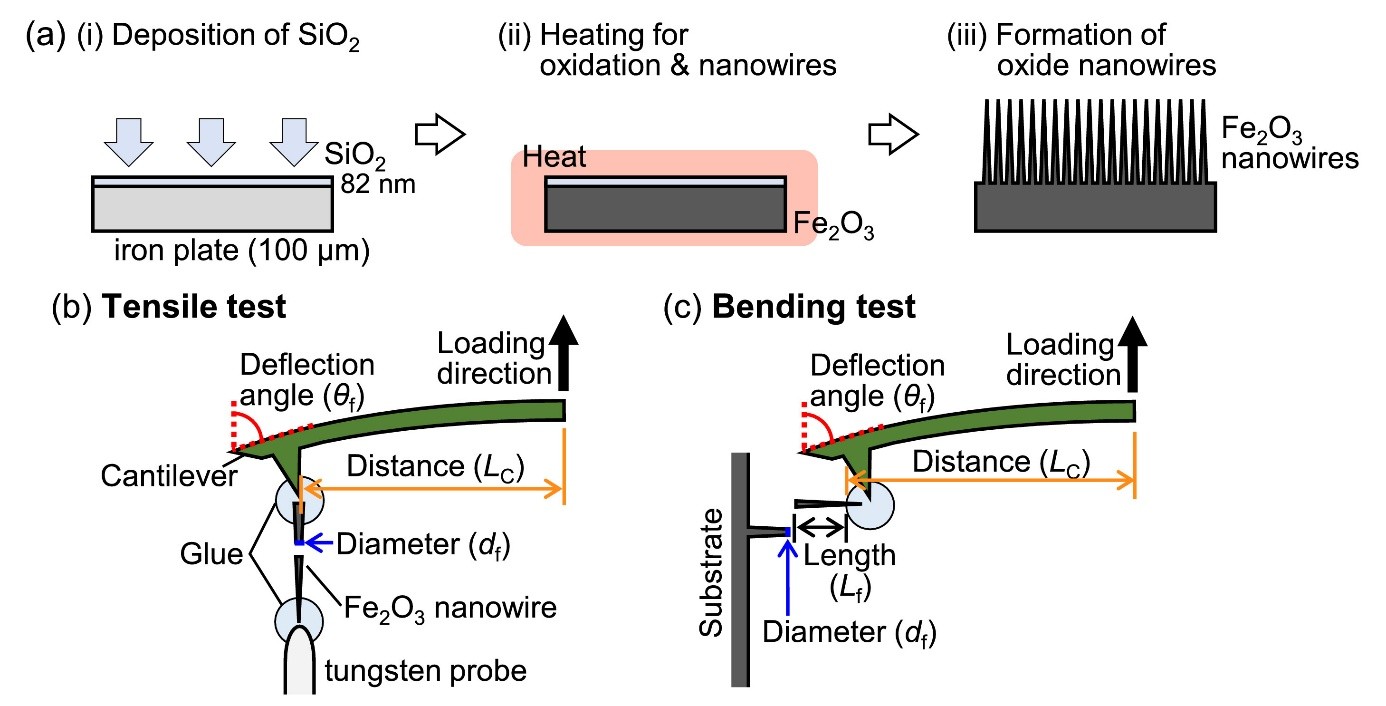
Fig. 1. (a) Formation process of Fe2O3 nanowires. Schematics of (b) tensile and (c) bending tests conducted on single Fe2O3 nanowires.
The study further demonstrates the functional potential of these structures through a chemical sensor based on Fe₂O₃ nanowires integrated on the substrate. The resulting sensor showed good sensing behaviour and high durability when exposed to ethanol solutions.
The work demonstrates how a NANOSENSORS AFM probe can be incorporated into a highly specialised experimental setup for mechanical testing at the nanoscale. By combining the mechanical properties of an AFM cantilever with precise nanomanipulation and in-situ electron microscopy, the researchers were able to directly evaluate the strength and fracture behaviour of individual nanowires.
For researchers working with nanowires, nanodevices, sensors, and other low-dimensional materials, this type of approach opens possibilities for investigating mechanical properties at the level where individual structures actually operate.
The NANOSENSORS uniqprobe qp-fast therefore plays a role beyond conventional AFM imaging: in this article, the AFM cantilever becomes an active component of a nanoscale mechanical testing platform, helping translate controlled cantilever movement into measurable forces acting on individual Fe₂O₃ nanowires.Full citation:
Kimura, Y.; Osari, S.; Shirasu, K.; Tohmyoh, H.
Experimental evaluation of the mechanical properties of iron oxide nanowires for chemical sensor applications.
Applied Surface Science Advances 2026, 34, 101001.
DOI: 10.1016/j.apsadv.2026.101001