Two-dimensional van der Waals ferromagnets continue to reveal unexpected magnetic phenomena that challenge the traditional understanding of magnetic ordering. In this article, Sergey Y. Grebenchuk, Magdalena Grzeszczyk, Zhaolong Chen, Makars Šiškins, Vladislav Borisov, Manuel Pereiro, Mikhail I. Katsnelson, Olle Eriksson, Kostya S. Novoselov, and Maciej Koperski investigate the origin of correlated magnetic sub-domains in mechanically exfoliated CrBr₃ and demonstrate how these nanoscale magnetic structures define an unconventional magnetic phase diagram.
By combining Magnetic Force Microscopy (MFM), ab initio calculations, and micromagnetic simulations, the authors reveal that vertically correlated planar magnetic sub-domains naturally form within van der Waals ferromagnetic layers. Rather than behaving as a single uniformly magnetized crystal, exfoliated CrBr₃ develops magnetic regions separated by stacking faults that locally modify the interlayer exchange coupling. These observations enabled the construction of a new phase diagram describing magnetic states through the degree of correlation between magnetic sub-domains as a function of temperature and external magnetic field.
Magnetic Force Microscopy was the key experimental technique for directly visualizing these nanoscale magnetic textures. High-resolution magnetic imaging was performed using NANOSENSORS SSS-MFMR MFM probes, while NANOSENSORS PPP-MFMR MFM probes were employed where enhanced magnetic sensitivity was required. Before imaging, the MFM probes were magnetized using a neodymium magnet to ensure stable magnetic contrast throughout the experiments.
The MFM measurements were carried out in both tapping mode and non-contact lift mode, allowing the magnetic signal to be separated from surface topography. Lift heights were carefully optimized according to sample thickness and magnetic state, ranging from approximately 20–30 nm for thin CrBr₃ flakes to as much as 300 nm near magnetic saturation. This strategy minimized magnetic domain dragging by the MFM probe while preserving excellent sensitivity to weak magnetic interactions.
This article demonstrates how NANOSENSORS MFM probes enable high-resolution imaging of complex magnetic domain structures in two-dimensional magnetic materials. By combining the high spatial resolution of the NANOSENSORS SSS-MFMR MFM probe with the enhanced sensitivity of the NANOSENSORS PPP-MFMR MFM probe, the researchers obtained detailed insight into the magnetic correlations that govern the behavior of van der Waals ferromagnets. These findings advance the understanding of low-dimensional magnetism and support future developments in spintronics, quantum materials, and nanoscale magnetic devices.
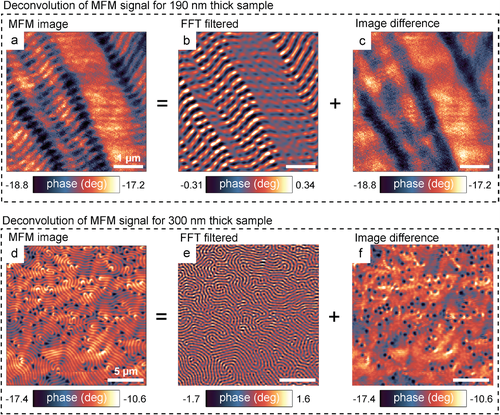
Figure 1
Coexistence of several domain sub-systems. a,d) MFM images obtained from CrBr3 crystals with thicknesses of 190 nm (a) and 300 nm (d), demonstrating complex patterns consisting of multiple systems of domains. Image (a) was deconvoluted into figures (b) and (c), and (d) into (e) and (f) using FFT filtering to highlight several overlaying domain patterns. The similarity index for domain sub-groups (b) and (c) is ξ = 0.26, and for (e) and (f) is ξ = 0.13. The sample-tip distance was 50 nm for (a) and 100 nm for (d).
Full citation:
Grebenchuk, S. Y.; Grzeszczyk, M.; Chen, Z.; Šiškins, M.; Borisov, V.; Pereiro, M.; Katsnelson, M. I.; Eriksson, O.; Novoselov, K. S.; Koperski, M.
Correlations in Magnetic Sub-Domains as an Unconventional Phase Diagram for van der Waals Ferromagnets.
Advanced Science 12(26), 2500562 (2025).
https://doi.org/10.1002/advs.202500562