Swiss National Day is an opportunity to celebrate the ingenuity, precision and commitment to quality that have become closely associated with Switzerland. While these qualities are often recognised in fields such as watchmaking, engineering and advanced manufacturing, they are equally evident in Swiss scientific research.
In work carried out at ETH Zürich and Empa, Tobias Armstrong and colleagues investigated how nanoscale surface structures influence the nucleation of calcium carbonate crystals, addressing a fundamental question in materials science.
Calcium carbonate is one of the most abundant minerals in nature. Beyond its role in shells and coral skeletons, it is also a major constituent of limestone, the rock that shapes many Alpine landscapes. The earliest stage of crystal formation—known as nucleation—is influenced by many factors, including the properties of the surface on which crystals begin to form.
To investigate this process, Tobias Armstrong and colleagues engineered model surfaces with well-defined nanoscale topographies while carefully controlling their surface chemistry. This approach allowed them to focus specifically on the role of nanoscale surface structure during crystal nucleation.
Reliable characterization of these engineered surface structures was an essential part of the study. Atomic force microscopy (AFM) was used to characterize the nanoscale topography of the fabricated surfaces before they were investigated in the nucleation experiments.
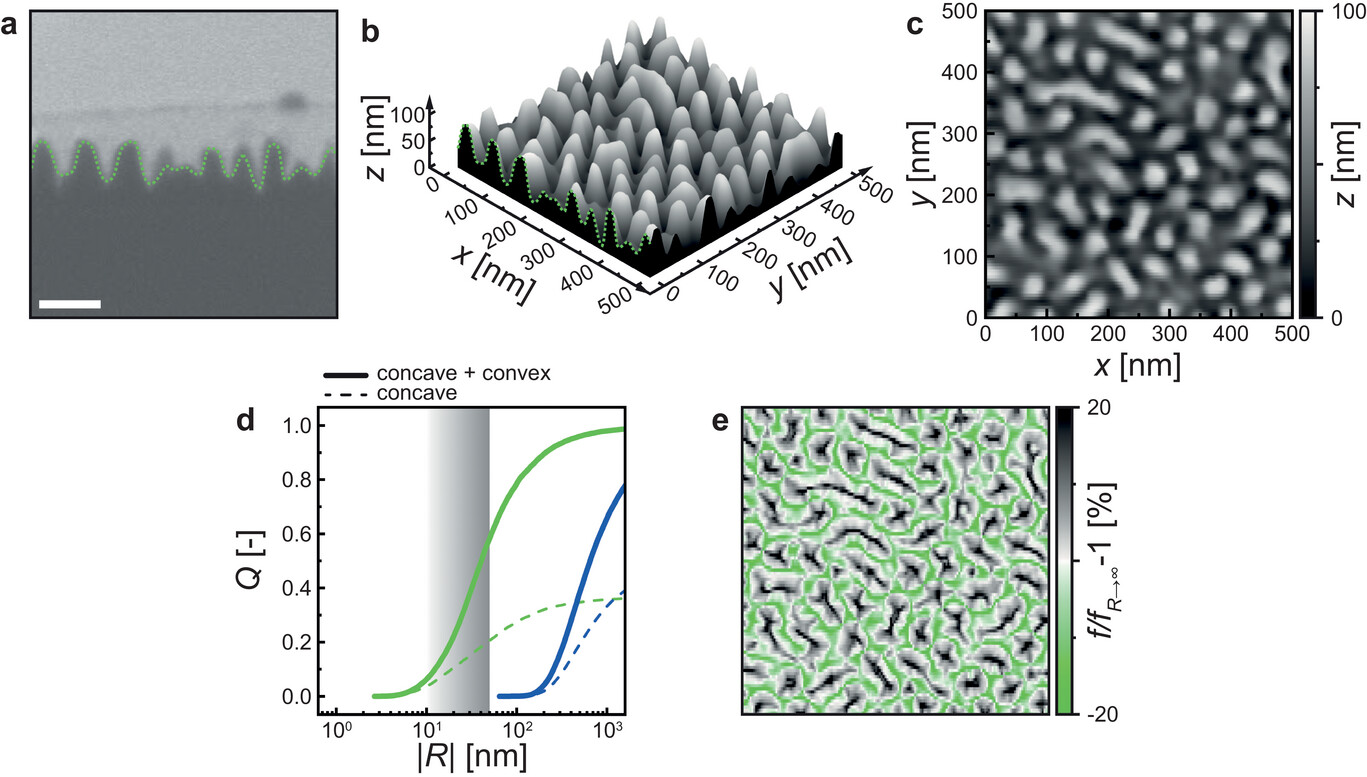
AFM characterization of representative nanoengineered surface topographies investigated in the study. These well-defined nanostructures illustrate the surfaces used to examine calcium carbonate nucleation. Adapted from Armstrong et al., Small (2024), Figure 2.
AFM probe: NANOSENSORS PointProbe® Plus PPP-NCH.
The authors showed that the nanoengineered surfaces exhibited substantially higher calcium carbonate nucleation rates than comparable smooth surfaces. Rather than being explained simply by the additional surface area created by the nanostructures, the experimental observations and theoretical analysis indicate that local surface nanocurvature, particularly within nano-pits, plays an important role in promoting nucleation.
Beyond advancing the understanding of calcium carbonate crystallization, the findings may help guide the design of future functional surfaces where controlling crystal nucleation is important. As the authors suggest, this knowledge could contribute to the development of scalephobic surfaces.
This Research Spotlight is based on the following publication:
Tobias Armstrong, Julian Schmid, Janne-Petteri Niemelä, Ivo Utke, and Thomas M. Schutzius
Nanostructured Surfaces Enhance Nucleation Rate of Calcium Carbonate
Small 20 (47), 2402690 (2024).
DOI: https://doi.org/10.1002/smll.202402690
Image Attribution and License
Figure 2 is adapted from the featured publication.
The original article is distributed under the terms of the Creative Commons Attribution 4.0 International License (CC BY 4.0). To view a copy of this license, visit: https://creativecommons.org/licenses/by/4.0/