Diamond-like carbon (DLC) coatings are widely used in engineering and materials science due to their excellent hardness, wear resistance, and low friction properties. In this article, Oskars Platnieks, Liutauras Marcinauskas, Hassan Zhairabany, Anatolijs Sarakovskis, Edgars Vanags, Sergejs Gaidukovs, Hesam Khaksar, and Enrico Gnecco investigate the effects of titanium doping and titanium–silver co-doping on the structural, tribological, and surface properties of hydrogen-free DLC films.
The authors prepared titanium-doped DLC (Ti-DLC) and titanium–silver co-doped DLC (Ti/Ag-DLC) coatings using magnetron sputtering and evaluated their morphology, chemical composition, mechanical properties, wettability, and friction behavior. While titanium incorporation resulted in only modest changes in surface roughness and graphitization, the addition of silver provided further control over surface chemistry and tribological performance. In particular, Ti/Ag co-doped films exhibited reduced surface oxidation and significantly lower coefficients of friction compared with undoped DLC coatings.
Atomic force microscopy (AFM) played a central role in characterizing both surface topography and nanotribological behavior. Surface imaging and roughness analysis were performed using NANOSENSORS PointProbe® Plus PPP-NCHR AFM probes operating in tapping mode.
Nanotribological investigations were carried out using NANOSENSORS PointProbe® Plus PPP-LFMR AFM probes operated in Lateral Force Microscopy (LFM) mode. Friction measurements were conducted under controlled normal loads ranging from 1 to 10 nN, allowing quantitative evaluation of the effects of metal doping on frictional performance. The results demonstrated that both Ti-DLC and Ti/Ag-DLC coatings can reduce friction by up to twofold compared with undoped DLC films.
This study highlights how advanced AFM characterization using NANOSENSORS PointProbe® Plus AFM probes contributes to understanding the relationship between composition, surface topography, nanomechanical behavior, and tribological performance in functional coating materials. The findings provide valuable insights for the development of next-generation DLC coatings with tunable hardness, roughness, wettability, and friction properties.
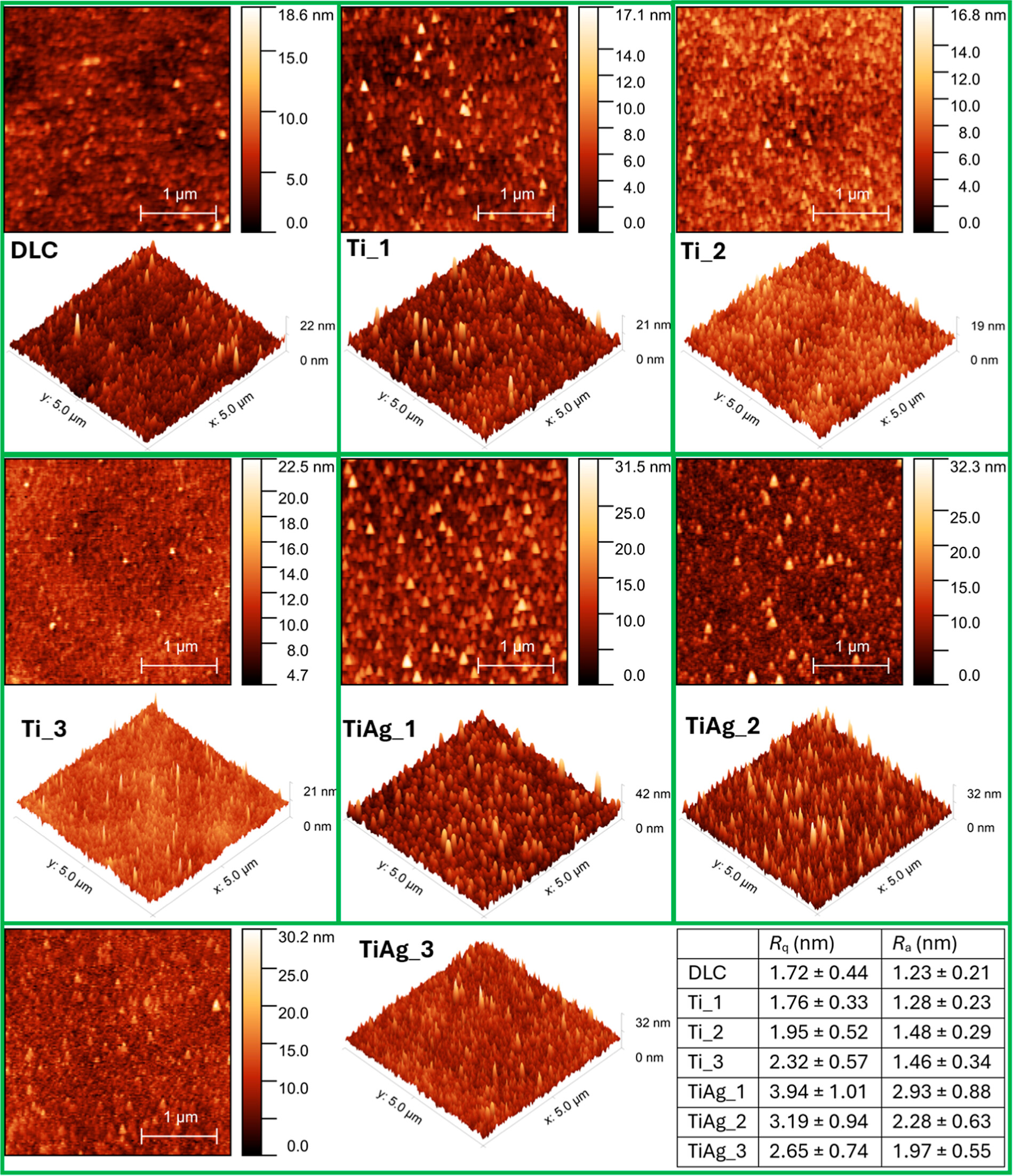
Figure 4. AFM surface morphology micrographs 2D (3 × 3 μm2) and 3D (5 × 5 μm2) for Ti-DLC and Ti/Ag-DLC films at various dopant levels. The accompanying table lists Rq (root mean square roughness) and Ra (arithmetic average roughness) for each film.
Full citation:
Platnieks, O.; Marcinauskas, L.; Zhairabany, H.; Sarakovskis, A.; Vanags, E.; Gaidukovs, S.; Khaksar, H.; Gnecco, E.
Comparative Study of Titanium-Doped and Titanium–Silver Co-Doped Diamond-Like Carbon Films.
ACS Omega 2026, 11(1), 1970–1980.
https://doi.org/10.1021/acsomega.5c10368
The article “Comparative Study of Titanium-Doped and Titanium–Silver Co-Doped Diamond-Like Carbon Films” is licensed under a Creative Commons Attribution 4.0 International License, which permits use, sharing, adaptation, distribution and reproduction in any medium or format, as long as you give appropriate credit to the original author(s) and the source, provide a link to the Creative Commons license, and indicate if changes were made. The images or other third-party material in this article are included in the article’s Creative Commons license, unless indicated otherwise in a credit line to the material. If material is not included in the article’s Creative Commons license and your intended use is not permitted by statutory regulation or exceeds the permitted use, you will need to obtain permission directly from the copyright holder. To view a copy of this license, visit https://creativecommons.org/licenses/by/4.0/.