Metal nanoparticles are widely used in biomedical applications due to their unique plasmonic and optical properties. In this article, Pauline Kolar-Hofer, Giulia Zampini, Christian Georg Derntl, Enrica Soprano, Ester Polo, Pablo del Pino, Nurgul Kereyeva, Moritz Eggeling, Leoni Breth, Michael J. Haslinger, Michael Mühlberger, Peter Ertl, Astrit Shoshi, Julian Hartbaum, Michael Jurisch, Beatriz Pelaz, and Stefan Schrittwieser present a fabrication strategy for producing nanoparticles with highly controllable plasmonic properties.
The authors combined nanoimprint lithography with thin film deposition to fabricate homogeneous nanoparticles with batch-to-batch variations below 5% for key geometrical parameters. Optical characterization demonstrated excellent agreement between simulations and experimental measurements, highlighting the potential of predictive modeling for designing nanoparticles with tailored plasmonic responses.
The fabricated nanoparticles additionally exhibited stable dispersion behavior after PEG surface functionalization and demonstrated good biocompatibility in vitro with low cytotoxicity. These characteristics support their potential use in biomedical imaging, sensing, photothermal therapy, and drug delivery applications.
Atomic force microscopy (AFM) was employed to characterize surface topography during nanoparticle fabrication and analysis. Scanning force microscopy measurements were performed using a NANOSENSORS SuperSharpSilicon SSS-NCHR AFM probe ( typical tip radius 2 nm) operated in acoustic mode. AFM imaging enabled detailed nanoscale characterization of the sample surface morphology and nanoparticle-related topographic features.
This work highlights how high-resolution AFM analysis using a NANOSENSORS AFM probe complements advanced nanoparticle fabrication approaches for biomedical nanotechnology applications.
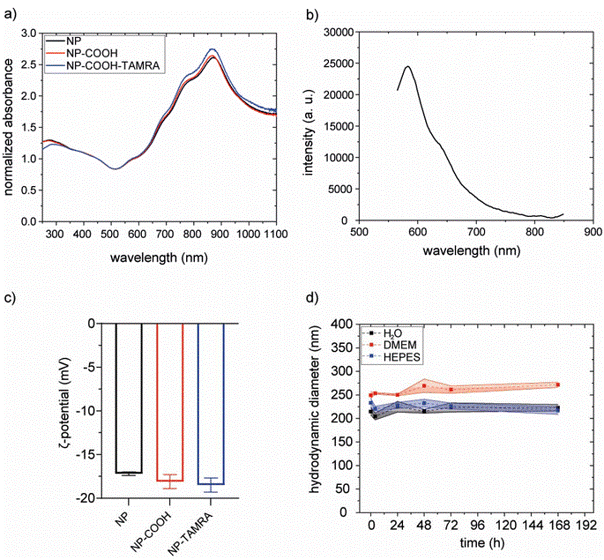
Fig. 6 (a) Normalized (@450 nm) extinction spectra of bare NPs (black line), after PEGylation (NP-COOH, red line) and after TAMRA labelling (NP-COOH-TAMRA, blue line). (b) Emission spectrum of NP-COOH-TAMRA (λexc = 530 nm). (c) Graphical representation of zeta potential values of bare NPs (−17.2 ± 0.2 mV, black bar), NP-COOH (−18.1 ± 0.8 mV, red bar) and NP-COOH-TAMRA (−18.5 ± 0.8 mV, blue bar). (d) Colloidal stability over time of NP-COOH-TAMRA in different media such as water (black), complete cell medium (DMEM, red) and HEPES buffer (pH 7.4, blue); the standard deviation is visually depicted using a shaded area proportional to the variability in the data.
Full citation:
Kolar-Hofer, P.; Zampini, G.; Derntl, C. G.; Soprano, E.; Polo, E.; del Pino, P.; Kereyeva, N.; Eggeling, M.; Breth, L.; Haslinger, M. J.; Mühlberger, M.; Ertl, P.; Shoshi, A.; Hartbaum, J.; Jurisch, M.; Pelaz, B.; Schrittwieser, S.
Fabrication of nanoparticles with precisely controllable plasmonic properties as tools for biomedical applications.
Nanoscale 2025, 17, 4423–4438.
https://doi.org/10.1039/D4NR02677B
The article “Fabrication of nanoparticles with precisely controllable plasmonic properties as tools for biomedical applications” is licensed under a Creative Commons Attribution 3.0 International License, which permits use, sharing, adaptation, distribution and reproduction in any medium or format, as long as you give appropriate credit to the original author(s) and the source, provide a link to the Creative Commons license, and indicate if changes were made. The images or other third-party material in this article are included in the article’s Creative Commons license, unless indicated otherwise in a credit line to the material. If material is not included in the article’s Creative Commons license and your intended use is not permitted by statutory regulation or exceeds the permitted use, you will need to obtain permission directly from the copyright holder. To view a copy of this license, visit https://creativecommons.org/licenses/by/3.0/.