Relaxor ferroelectrics exhibit complex electromechanical responses that are critical for advanced functional materials. In this article, C. Saguy, B. Kowalski, A. Sehirlioglu, and Y. Ivry report non-ergodic-induced negative differential piezoresponse behavior.
Piezoresponse force microscopy (PFM) was used to investigate domain switching and nanoscale electromechanical properties. The study reveals unconventional polarization responses associated with non-ergodic states. Measurements were carried out using a NANOSENSORS Platinum Silicide PtSi-FM AFM probe with a force constant of 2.5 N/m and a resonance frequency of 70 kHz. The AFM probe enabled high-resolution imaging, domain writing, and switching spectroscopy under controlled bias conditions.
This work highlights the role of NANOSENSORS AFM probes in enabling precise characterization of complex ferroelectric phenomena at the nanoscale.
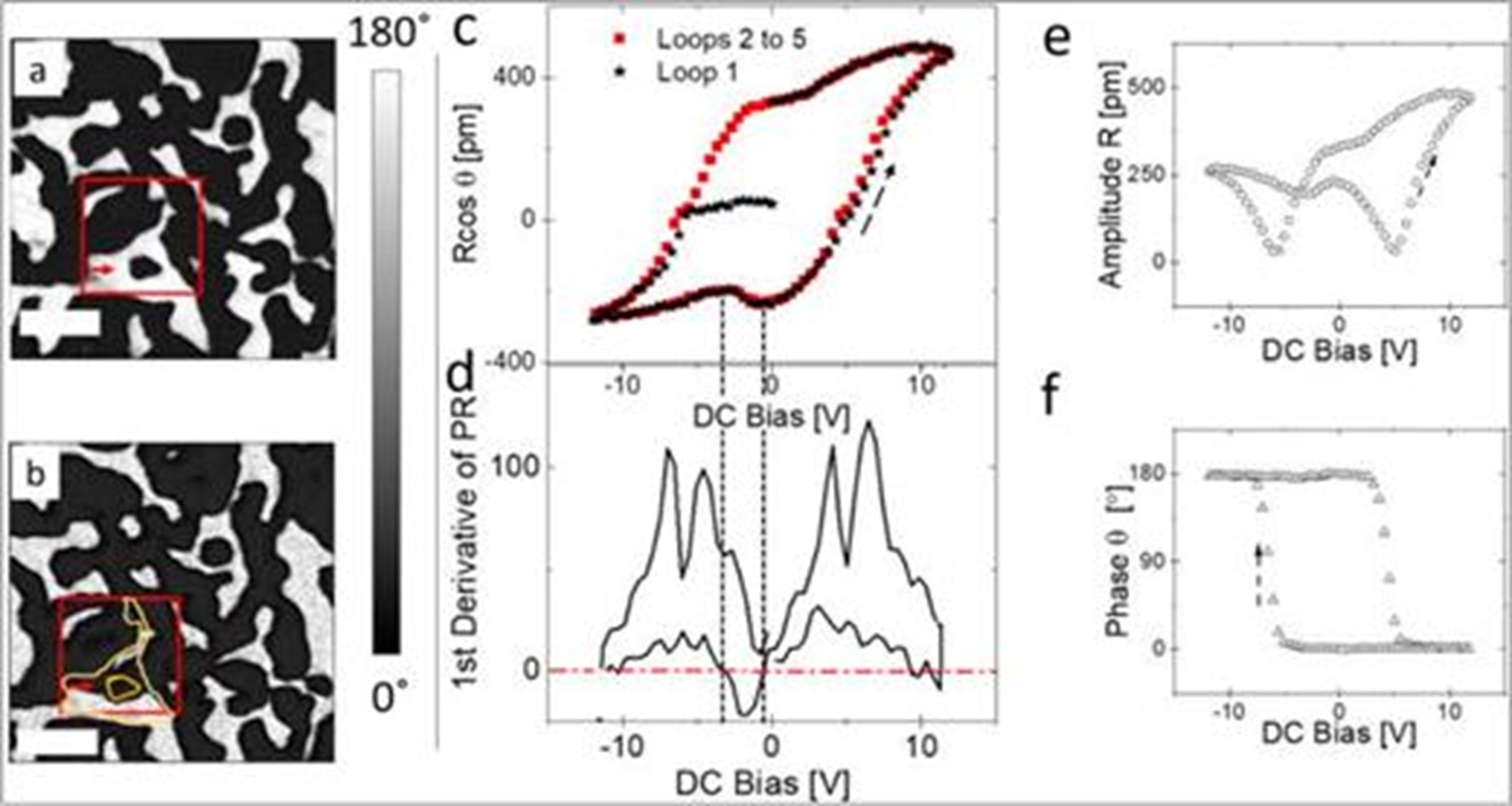
Polarization distribution and local hysteretic behavior in unpoled PMN–PT: (a) polarization distribution before and (b) after a local SSPFM measurement. Red arrows show the point where the hysteresis was done. The yellow lines indicate the contour of the original domains. The data scale on (a) and (b) is 0.5 μm. (c) Piezoresponse mixed signal during local hysteretic spectroscopy of five sequential loops. (d) Derivative of the hysteresis loop, exhibiting a region with negative differential piezoresponse (below the horizontal red dashed line). (e) Amplitude and (f) phase signals of the hysteretic loop in (b). The dashed arrows show the direction of the loop, amplitude, and phase. Data were collected at 60 °C.
Full citation:
Saguy, C.; Kowalski, B.; Sehirlioglu, A.; Ivry, Y.
Non-ergodic-induced negative differential piezoresponse in relaxor ferroelectrics.
Applied Physics Letters 2025, 126, 072903.
https://doi.org/10.1063/5.0243964
The article “Non-ergodic-induced negative differential piezoresponse in relaxor ferroelectrics” is licensed under a Creative Commons Attribution 4.0 International License, which permits use, sharing, adaptation, distribution and reproduction in any medium or format, as long as you give appropriate credit to the original author(s) and the source, provide a link to the Creative Commons license, and indicate if changes were made. The images or other third-party material in this article are included in the article’s Creative Commons license, unless indicated otherwise in a credit line to the material. If material is not included in the article’s Creative Commons license and your intended use is not permitted by statutory regulation or exceeds the permitted use, you will need to obtain permission directly from the copyright holder. To view a copy of this license, visit https://creativecommons.org/licenses/by/4.0/.