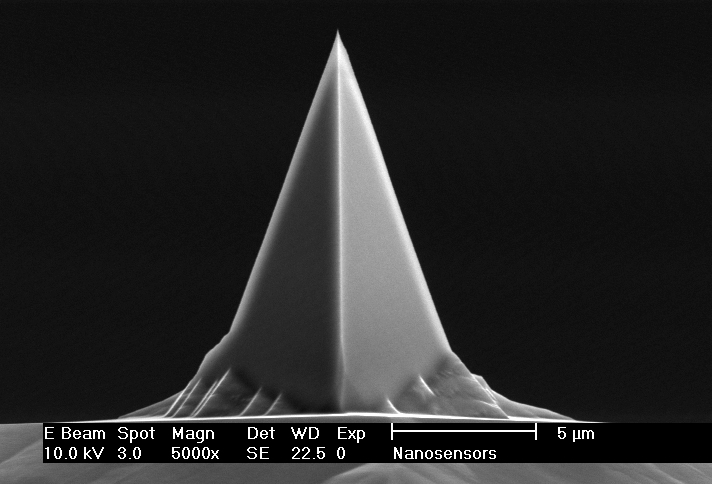
PPP-NCLAu

Cantilever data:
Property Nominal Value Specified Range
Resonance Frequency [kHz] 190 146 - 236
Force Constant [N/m] 48 21 - 98
Length [µm] 225 215 - 235
Mean Width [µm] 38 30 - 45
Thickness [µm] 7 6 - 8
Order codes and shipping units:
Order Code AFM probes per pack Data sheet
PPP-NCLAu-10 10 of all probes
NANOSENSORS™ PointProbe® Plus AFM Probes

PointProbe® Plus Non-Contact /Tapping Mode - Long Cantilever - Au coating

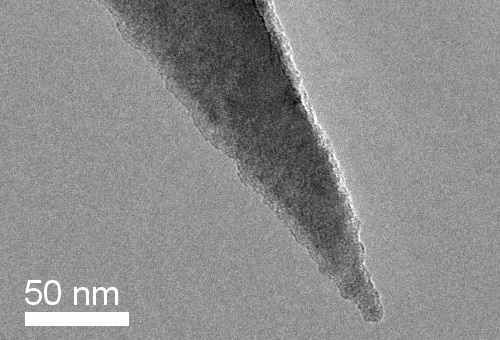
The PointProbe® Plus (PPP) combines high application versatility and compatibility with most commercial SPMs. The typical AFM tip radius of less than 7 nm and the minimized variation in AFM tip shape provide reproducible images and enhanced resolution.

NANOSENSORS™ PPP-NCLAu probes are designed for non-contact mode or tapping mode AFM (also known as: attractive or dynamic mode). The NCL type is offered as an alternative to NANOSENSORS™ high frequency non contact type (NCH). PPP-NCLAu is recommended if the feedback loop of the microscope does not accept high frequencies (400 kHz) or if the detection system needs a minimum AFM cantilever length > 125 µm. Compared to the high frequency non-contact type NCH the maximum scanning speed is slightly reduced. This AFM probe type combines high operation stability with outstanding sensitivity and fast scanning ability.

The AFM probe offers unique features:

  • metallic conductivity of the AFM tip
  • AFM tip height 10 - 15 µm
  • Au coating on both sides of the AFM cantilever
  • chemically inert

A metallic layer (Au) is coated on both sides of the AFM cantilever. The tip side coating enhances the conductivity of the AFM tip and allows electrical contacts - the typical AFM tip radius of curvature is less than 50nm. The detector side coating enhances the reflectivity of the laser beam by a factor of 2.5 and prevents light from interfering within the AFM cantilever. The coating process is optimized for stress compensation. As the coating is nearly stress-free the bending of the AFM cantilever due to stress is less than 2 degrees.

Please note: Wear at the AFM tip can occur if operating in contact-, friction- or force modulation m

This AFM probe features alignment grooves on the back side of the holder chip. These grooves fit to the NANOSENSORS Alignment Chip.

Jahng J, Lee S, Hong SG, Lee CJ, Menabde SG, Jang MS, Kim DH, Son J, Lee ES
Characterizing and controlling infrared phonon anomaly of bilayer graphene in optical-electrical force nanoscopy
Light: Science & Applications. 2023 Nov 24;12(1):281
DOI: https://doi.org/10.1038/s41377-023-01320-1


Lun Y, Wang X, Kang J, Ren Q, Wang T, Han W, Gao Z, Huang H, Chen Y, Chen LQ, Fang D
Ultralow tip‐force driven sizable‐area domain manipulation through transverse flexoelectricity
Advanced Materials. 2023 Sep;35(36):2302320
DOI: https://doi.org/10.1002/adma.202302320


Kim B, Jahng J, Sifat A, Lee ES, Potma EO
Monitoring fast thermal dynamics at the nanoscale through frequency domain photoinduced force microscopy
The Journal of Physical Chemistry C. 2021 Mar 24;125(13):7276-86
DOI: https://doi.org/10.1021/acs.jpcc.1c00874


Amargós-Reyes O, Maldonado JL, Martínez-Alvarez O, Nicho ME, Santos-Cruz J, Nicasio-Collazo J, Caballero-Quintana I, Arenas-Arrocena C
Nontoxic pyrite iron sulfide nanocrystals as second electron acceptor in PTB7: PC71BM-based organic photovoltaic cells
Beilstein journal of nanotechnology. 2019 Nov 14;10(1):2238-50
DOI: https://doi.org/10.3762/bjnano.10.216


Pobelov IV, Mészáros G, Yoshida K, Mishchenko A, Gulcur M, Bryce MR, Wandlowski T
An approach to measure electromechanical properties of atomic and molecular junctions
Journal of Physics: Condensed Matter. 2012 Mar 30;24(16):164210
DOI: https://doi.org/10.1088/0953-8984/24/16/164210