PPP-CONTSC

Cantilever data:
Property Nominal Value Specified Range
Resonance Frequency [kHz] 25 1 - 57
Force Constant [N/m] 0.2 0.01 - 1.87
Length [µm] 225 215 - 235
Mean Width [µm] 48 40 - 55
Thickness [µm] 1 0.1 - 2
Order codes and shipping units:
Order Code AFM probes per pack Data sheet
PPP-CONTSC-10 10 of all probes
PPP-CONTSC-20 20 of all probes
PPP-CONTSC-50 50
PPP-CONTSC-W 380 of up to 32 probes
NANOSENSORS™ PointProbe® Plus AFM Probes

PointProbe® Plus Contact Mode Short Cantilever

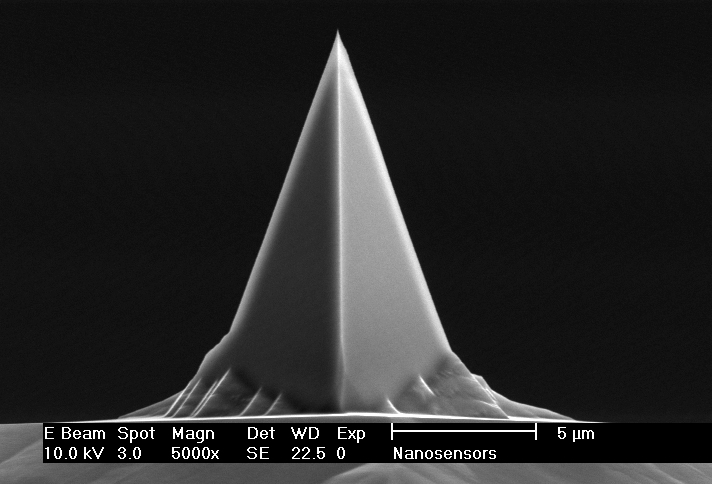
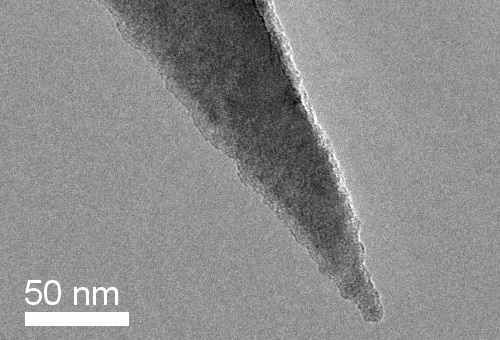
The PointProbe® Plus (PPP) combines high application versatility and compatibility with most commercial SPMs. The typical AFM tip radius of less than 7 nm and the minimized variation in AFM tip shape provide reproducible images and enhanced resolution.

The NANOSENSORS™ PPP-CONTSC is an alternative AFM cantilever type for contact mode applications. The length of AFM cantilever is reduced with respect to the preferred contact mode type enabling easier exchange with non-contact mode AFM probes for some AFM instruments. Additionally, this AFM probe type allows the application for lateral or friction force mode.

The AFM probe offers unique features:

  • guaranteed AFM tip radius of curvature < 10 nm
  • AFM tip height 10 - 15 µm
  • highly doped silicon to dissipate static charge
  • high mechanical Q-factor for high sensitivity
  • alignment grooves on backside of silicon holder chip
  • precise alignment of the AFM cantilever position (within +/- 2 µm) when used with the Alignment Chip
  • compatible with PointProbe® Plus XY-Alignment Series
This AFM probe features alignment grooves on the back side of the holder chip. These grooves fit to the NANOSENSORS Alignment Chip.

Koellisch‐Mirbach A, Park I, Baltruschat H
The Electrochemistry of Sodiumdodecylsulfonate on Au (111) in sulfuric acid–Voltammetry
Adsorbate structure and Friction
DOI: https://doi.org/10.26434/chemrxiv-2025-c4gmj


Paul A, Volk A, Hokmabadi M, Rigo E, Kermani H, Almonte‐Garcia L, Finamore TA, Iwamoto KM, Roeder RK, Timp G
Modular Assembly of Metamaterials Using Light Gradients
Advanced Materials. 2024 Aug;36(35):2401344
DOI: https://doi.org/10.1002/adma.202401344


Park I, Baltruschat H
Atomic-scale friction study by EC-AFM: underpotential deposition (UPD) of Ag on I-modified Au (111) and its tip penetration
Journal of The Electrochemical Society. 2022 Dec 5;169(12):122501
DOI: https://doi.org/10.1149/1945-7111/aca2e6


Svistkov AL, Izyumov RI
Influence of intermolecular interaction force on the jump magnitude of the atomic force microscope probe during indentation of soft material
Nanoscience and Technology: An International Journal. 2020;11
DOI: https://doi.org/10.1615/NanoSciTechnolIntJ.202003262


Shoaib T, Nalam PC, He Y, Chen Y, Espinosa-Marzal RM
Assembly, morphology, diffusivity, and indentation of hydrogel-supported lipid bilayers
Langmuir. 2017 Jul 18;33(28):7105-17
DOI: https://doi.org/10.1021/acs.langmuir.7b01062


Iqbal S, Bondü C, Baltruschat H
Quantitative determination of H2Se at model metal fcc (111) selenide surface: DEMS, STM, and AFM studies
The Journal of Physical Chemistry C. 2015 Sep 3;119(35):20515-23
DOI: https://doi.org/10.1021/acs.jpcc.5b06635