Elkrief D, Cheng YS, Rassier DE
Investigating the Inhibitory Effects of Blebbistatin on Actomyosin Interactions in Myofibrils and Isolated Myofilaments
bioRxiv. 2025 Feb 21:2025-02
DOI: https://doi.org/10.1101/2025.02.17.638391
Caballero-Quintana I, Amargós-Reyes O, Maldonado JL, Nicasio-Collazo J, Romero-Borja D, Barreiro-Argüelles D, Molnár G, Bousseksou A
Scanning probe microscopy analysis of nonfullerene organic solar cells
ACS Applied Materials & Interfaces. 2020 May 29;12(26):29520-7
DOI: https://doi.org/10.1021/acsami.0c06048
Haeger R, de Souza Leite F, Rassier DE
Sarcomere length non-uniformities dictate force production along the descending limb of the force–length relation
Proceedings of the Royal Society B. 2020 Oct 28;287(1937):20202133
DOI: https://doi.org/10.1098/rspb.2020.2133
Kumar M, Som T, Kim J
A transparent photonic artificial visual cortex
Advanced Materials. 2019 Sep;31(39):1903095.
DOI: https://doi.org/10.1002/adma.201903095
Yang DS, Bilby D, Chung K, Wenderott JK, Jordahl J, Kim BH, Lahann J, Green PF, Kim J
Work Function Modification via Combined Charge‐Based Through‐Space Interaction and Surface Interaction.
Advanced Materials Interfaces. 2018 Aug;5(15):1800471
DOI: https://doi.org/10.1002/admi.201800471
Shalabi N, Persson M, Månsson A, Vengallatore S, Rassier DE
Sarcomere stiffness during stretching and shortening of rigor skeletal myofibrils
Biophysical Journal. 2017 Dec 19;113(12):2768-76
DOI: https://doi.org/10.1016/j.bpj.2017.10.007
Leite FS, Minozzo FC, Kalganov A, Cornachione AS, Cheng YS, Leu NA, Han X, Saripalli C, Yates 3rd JR, Granzier H, Kashina AS
Reduced passive force in skeletal muscles lacking protein arginylation
American Journal of Physiology-Cell Physiology. 2016 Jan 15;310(2):C127-35
DOI: https://doi.org/10.1152/ajpcell.00269.2015
Lorenzoni M, Giugni A, Di Fabrizio E, Pérez-Murano F, Mescola A, Torre B
Nanoscale reduction of graphene oxide thin films and its characterization
Nanotechnology. 2015 Jun 29;26(28):285301
DOI: https://doi.org/10.1088/0957-4484/26/28/285301
Kurosaka S, Leu NA, Pavlov I, Han X, Ribeiro PA, Xu T, Bunte R, Saha S, Wang J, Cornachione A, Mai W
Arginylation regulates myofibrils to maintain heart function and prevent dilated cardiomyopathy Journal of molecular and cellular cardiology. 2012 Sep 1;53(3):333-41
DOI:
https://doi.org/10.1016/j.yjmcc.2012.05.007






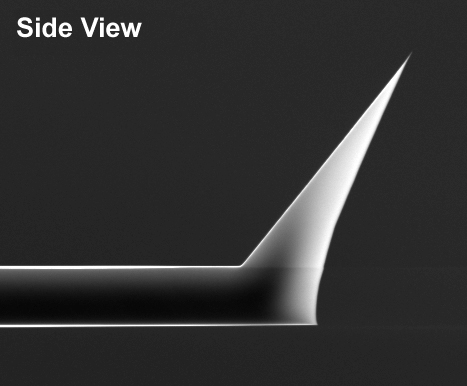
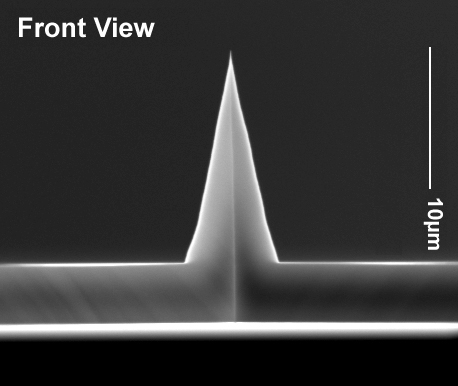
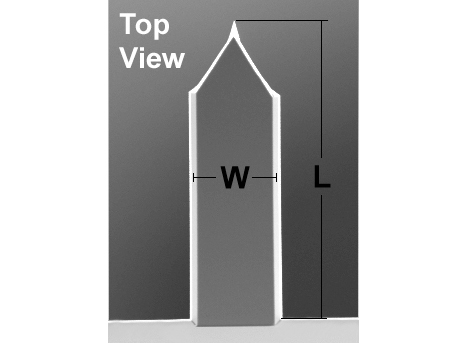
 Due to their unique geometry the tips of the AdvancedTEC probes are more susceptible to tip damage by electrostatic discharge (ESD) than other Silicon-SPM-Probes.